SaaS content marketing
Content Strategy vs. Content Calendar: Why Most SaaS Content Doesn't Compound
Zadhid Powell · 6 min read

On this page
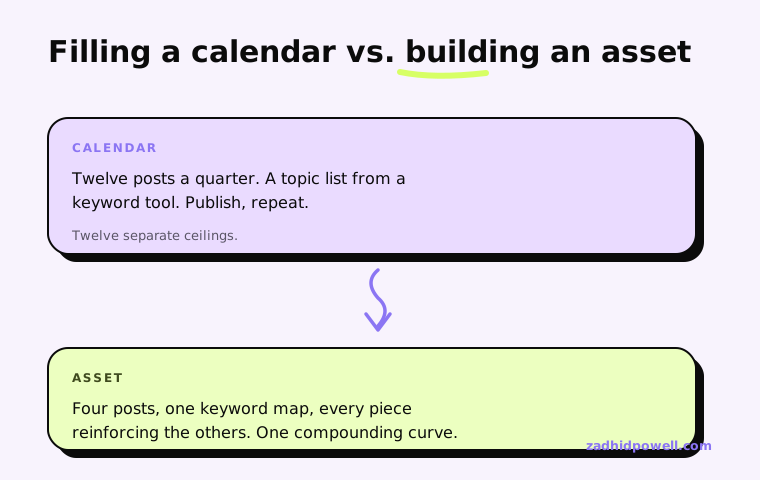
Most SaaS content teams are optimized to fill a calendar. Twelve posts a quarter, a topic list pulled from a keyword tool, a publish button pressed on schedule.
None of that is wrong exactly. It's just not the job. The job is building something that keeps paying off months after you've stopped thinking about it.
I've watched the difference between those two jobs play out directly, in a rebuild that took a scattered content library and turned it into something that compounded.
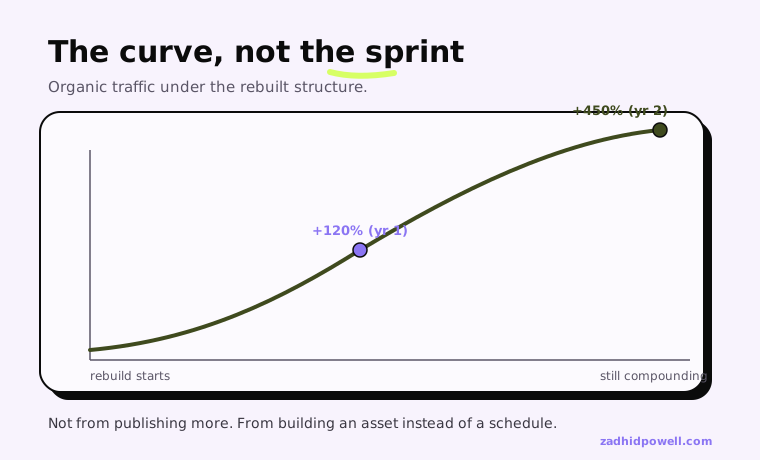
The short version: organic traffic grew roughly 120 percent in the first year, and roughly 450 percent by the second. Publishing more wasn't the cause. Building an asset instead of a schedule was.
This piece is the compounding half of the SaaS content system: what actually separates a blog that pays you back from one that just keeps shipping.
What "Asset, Not Output" Actually Means
An output is something you finish. An asset is something that keeps working after you finish it.
A blog post is output the moment it publishes. It only becomes an asset once it's ranking, getting linked to, answering a real question, and sitting inside a structure other pages reinforce.
Most content calendars are built to produce output. Turning that output into an asset isn't a writing task. It's an architecture task, and almost nobody budgets time for it.
That's the actual gap between a company that publishes fifty posts a year and one that publishes twenty and gets more out of them.
The ShortPixel Rebuild
I took over as head of the content team at ShortPixel after the company had spent time working with an outside content-publishing agency.
A publishing agency's job is to ship articles on schedule. That's a real job. It just isn't the same job as building a content asset, and the difference showed up in what I inherited.
The library was scattered. Some pieces overlapped. Some quietly contradicted each other. None of it was organized around a coherent keyword map, because nobody had built one.
My first job wasn't writing new content. It was reading the existing library the way an editor checks facts, then rebuilding the keyword research from the ground up.
I reorganized the entire plan into topic clusters that hadn't existed before, folding the salvageable old articles in alongside new ones instead of starting from zero.
Organic traffic grew roughly 120 percent in the first year under that structure, and roughly 450 percent by the second year.
That growth didn't come from writing faster. It came from making every piece point toward the same map, so a reader landing on any one of them could find three more that answered the question they'd actually ask next.
Content Strategy vs. Content Calendar: Why Clusters Compound
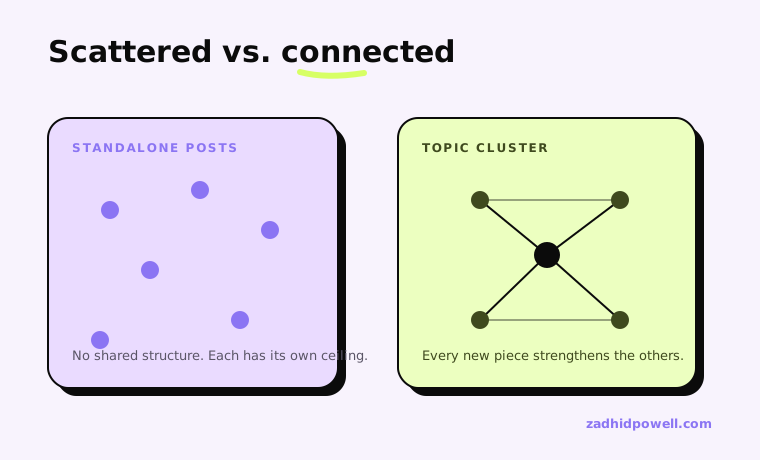
A standalone post has a ceiling the moment it publishes: whatever traffic that one keyword can bring in, and nothing more.
A cluster has a property a standalone post never gets. Every new piece added to it makes the others rank a little better, because it's more internal signal pointing at the same topic.
This is also what search engines are built to reward. Google's own guidance on helpful, people-first content is explicit that depth and topical completeness, not post count, are what it's trying to identify.
A twelve-post calendar with no shared structure produces twelve separate ceilings. A four-post cluster with a shared keyword map produces one compounding curve.
Pro tip: Before you write a new post, ask which existing piece it should link up to and which one should link back. If you can't answer that in one sentence, it's not part of a cluster yet. It's still just output.
What Compounding Looks Like, Month Over Month
It rarely looks dramatic in any single month. The first quarter of a real cluster rebuild can look slower than the volume-driven calendar it replaced, because the time is going into architecture, not publish count.
The curve usually bends later, somewhere in the back half of year one, once enough of the cluster is live for the internal linking to start doing real work.
By month eighteen to twenty-four, the pieces published in month one are still growing, not decaying. That's the real signal you built an asset instead of shipping output.
Content Marketing Institute's 2025 B2B research found only one in three B2B marketers say they have a scalable model for producing content. A cluster, built once and compounding after, is what a scalable model actually looks like.
Gartner's research on the B2B buying journey found buyers now spend roughly 80 percent of their purchase process alone, over a stretch that runs months, not days. Content that's still ranking and answering questions a year after it published is what actually survives a journey that long.
How to Start Treating Content Like an Asset
You don't need to throw out an existing calendar to start doing this. You need to stop treating every new piece as independent.
- Before you write anything new, map what you've already published against one keyword list. Overlaps and gaps both become visible immediately.
- Pick one topic cluster to rebuild first, not the whole site. A single working cluster teaches you more than a half-finished rebuild of everything.
- Every new brief should name which cluster it belongs to and which existing piece it links up to. No named cluster, no draft.
- Give it a full year before judging the curve. Compounding content is not a one-quarter bet.
This is the same discipline covered at the strategy level in the SaaS content system: map the buyer stages first, then build the cluster underneath them so it converts as it compounds.
A cluster that compounds traffic without converting any of it is still an unfinished asset. That specific gap gets its own piece.
The comparison and alternative pages inside a cluster tend to carry the most weight once the traffic exists. Here's how to build those well.
None of this matters if you can't tell whether the curve is actually bending. Here's how to measure it instead of guessing from traffic alone.
Frequently asked questions
What does it mean to treat content as an asset instead of output?
Output is finished the moment it publishes. An asset keeps paying off after that: it ranks, gets linked to, and sits inside a structure that reinforces other pieces on the same topic.
Most calendars are built to produce output. Almost none are built to produce assets, because that takes architecture, not just writing.
Why do content clusters compound and standalone posts don't?
A standalone post's traffic ceiling is set the moment it publishes. A cluster compounds because every new piece strengthens the internal signal pointing at the shared topic, which helps the whole group rank better, not just the newest post.
How long does it take for a content cluster to compound?
Real compounding usually shows up in the back half of year one, once enough of the cluster is live for internal linking to matter, and keeps building through year two.
The ShortPixel rebuild grew organic traffic roughly 120 percent in year one and roughly 450 percent by year two under this structure.
How do you turn an existing scattered blog into a compounding asset?
Map everything already published against one keyword list first. That surfaces overlaps and gaps immediately.
Then rebuild one cluster at a time instead of the whole site at once, and give every new brief a named cluster and an existing piece to link to.
Written by
Zadhid Powell
SaaS content strategist and technical writer. I help software companies turn product knowledge into content that ranks, gets cited by AI, and supports pipeline.
Keep reading
Working on this kind of problem?
If this is relevant to what you are building, let's talk about it.
Get in touch